
Regret Moving to USA? When the Dream and the Reality Don't Match
Car-bound loneliness, family who cannot easily visit and sky-high expectations: why you might regret moving to the USA, and what helps.
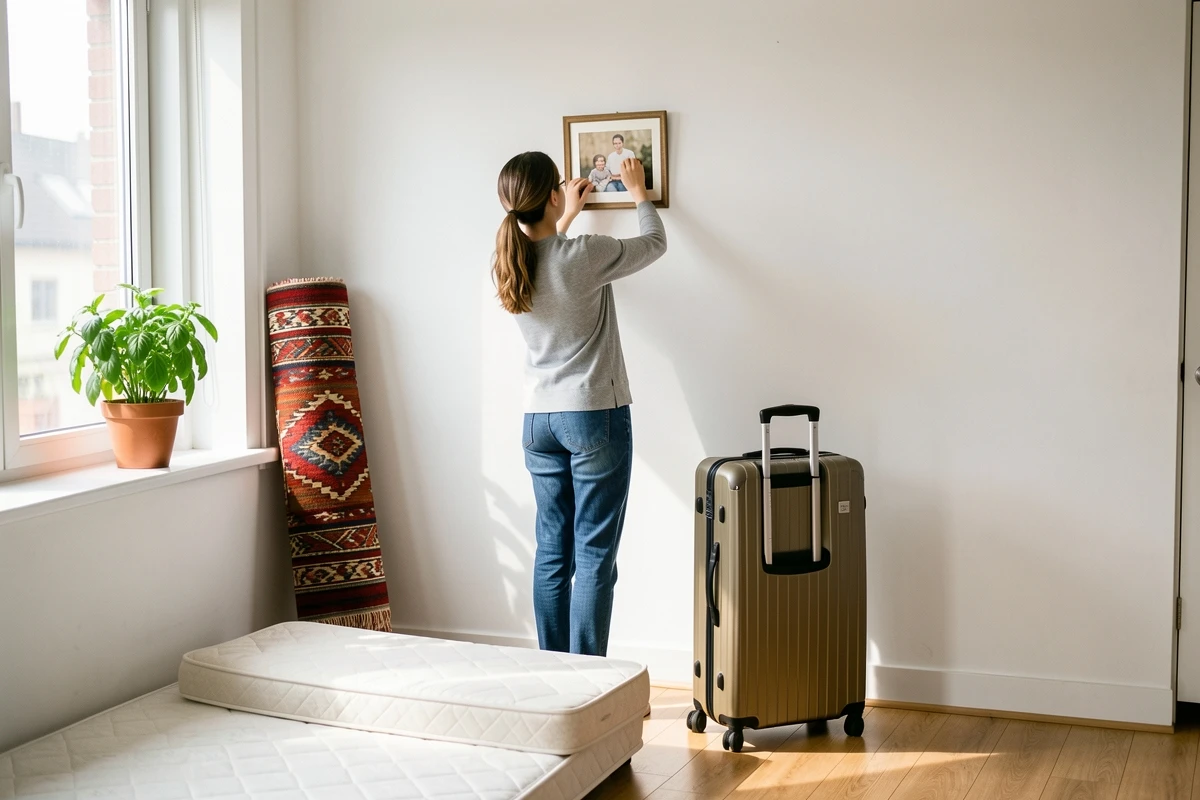
It's your first night. Your suitcase is open next to the bed, the room smells of fresh paint, and the message you sent home ("Arrived, all good") still shows one tick, because it's 3 a.m. back there. Moving abroad alone feels exactly like this: exciting and very quiet at the same time. Nobody tells you what to do, and nobody notices if you come home late. This article looks at both sides of that experience, and at how to slowly build a circle of people who can hold you up when things get hard.
When you move with a partner or family, there's at least one person who speaks your language, shares dinner with you and hears about your day at the immigration office. When you go alone, you build all of that from scratch.
Simple tasks carry more weight, too. Opening a bank account, finding a flat, your first winter cold: none of them is hard on its own, but with no one beside you, each becomes another decision and another worry. If you haven't left yet and these thoughts are already keeping you up, our piece on anxiety before moving abroad may help.
On the other hand, going alone means you only have to manage your own mood. You choose your path, and your mistakes are yours. Lightness and heaviness tend to arrive together.
Many Iranians have never lived alone before they leave. They go straight from their parents' home to a shared home, or if they did live alone, relatives were always dropping by. Now, maybe for the first time, you set your own sleep, your own meals and your own weekends.
That freedom isn't just comfort. It's a chance to get to know yourself. Without someone else's habits around you, you start to notice what you actually like: early mornings, a walk by the river, cooking a proper weekend dinner just for yourself. Some people use these years to start something there was never time for at home, like a sport, an instrument or a course.
Pay attention to this side as well. If you only focus on the hard parts, you stop seeing what you've gained.
The hardest moments of moving abroad alone are rarely the big ones. They're the small ones. A Sunday where you haven't spoken to anyone by evening. A birthday that passes with a few messages. Yalda night (the winter solstice gathering) or Nowruz (Persian New Year), when your family is gathered around the table on a video call and you're sitting in front of a laptop with a bowl of pomegranate seeds.
Another problem is that isolation becomes a habit. After a few weeks of staying in, going out gets harder. You answer messages later, turn down invitations, and then feel like nobody reaches out. This cycle forms more easily when you live alone, because there's no one at home to say "you haven't left the house in days."
There's one more trap: not telling your family. You don't want to worry them, so on every call you say everything's fine. Those smiles for the camera can make the loneliness deeper. We wrote more about this in loneliness after moving abroad.
A support network is a handful of people and places that keep showing up in your life. They don't all need to be close friends. A good network has layers.
The baker on your corner, a classmate from language school, the neighbor you pass on the stairs. These relationships are small, but they create the feeling that someone here knows you. A daily hello and a couple of sentences matter more than you'd expect.
Friendship grows from repetition more than from one exciting meeting. Choose a weekly class, a gym, a hiking group or a volunteer role and stick with it for a few months. People you see every week slowly move from strangers to acquaintances to friends.
An Iranian community can be a warm refuge: people who get your jokes and don't need Nowruz explained. But if all your relationships are Iranian, your new country stays outside your life. Try to have both.
Calling family matters. But if you spend hours on video calls every night and go to bed feeling heavy, it may help to set a regular time for them. Home should support you, not become a place you escape to from today's life.
Loneliness and homesickness in the first months are normal, and for many people they ease with time. But if you notice these signs, it's better not to handle them alone:
If you're having thoughts of harming yourself, call your local emergency number now: 112 in Europe, 911 in the US and Canada, 999 in the UK and 000 in Australia.
Talking to a psychologist who knows your language and culture helps you see which part of what you're feeling is a normal part of adjusting and which part needs more attention. In a NikMind pre-consultation we go over your situation and refer you to a suitable therapist. You can also read more about Dr. Meysam Nikdanesh and the clinic's approach. Sessions are online and in Farsi, so it doesn't matter which city or country you live in.
Yes, for many people it is, and it usually eases as you build routines and new relationships. If it has been getting worse for several weeks, talk to a professional.
There's no fixed timeline and it varies from person to person. Seeing the same people regularly in a weekly class or group usually speeds it up.
An Iranian community can feel familiar and safe, but relationships with locals help your new country feel like home. A mix of both works best.
You don't have to share everything, but hiding it completely tends to deepen loneliness. You might start by being more open with the family member who stays calmest.

PhD in Clinical Psychology, psychotherapist and founder of NikMind Clinic. Articles here are for general information and do not replace an assessment session with a psychologist or psychiatrist

Car-bound loneliness, family who cannot easily visit and sky-high expectations: why you might regret moving to the USA, and what helps.
Distance, upside-down seasons and life on a temporary visa: why you might regret moving to Australia, and what to try before deciding to go back.
Where an online visit in Farsi helps, why prescriptions and follow-up usually stay with a local doctor, and when you need to be seen in person.